
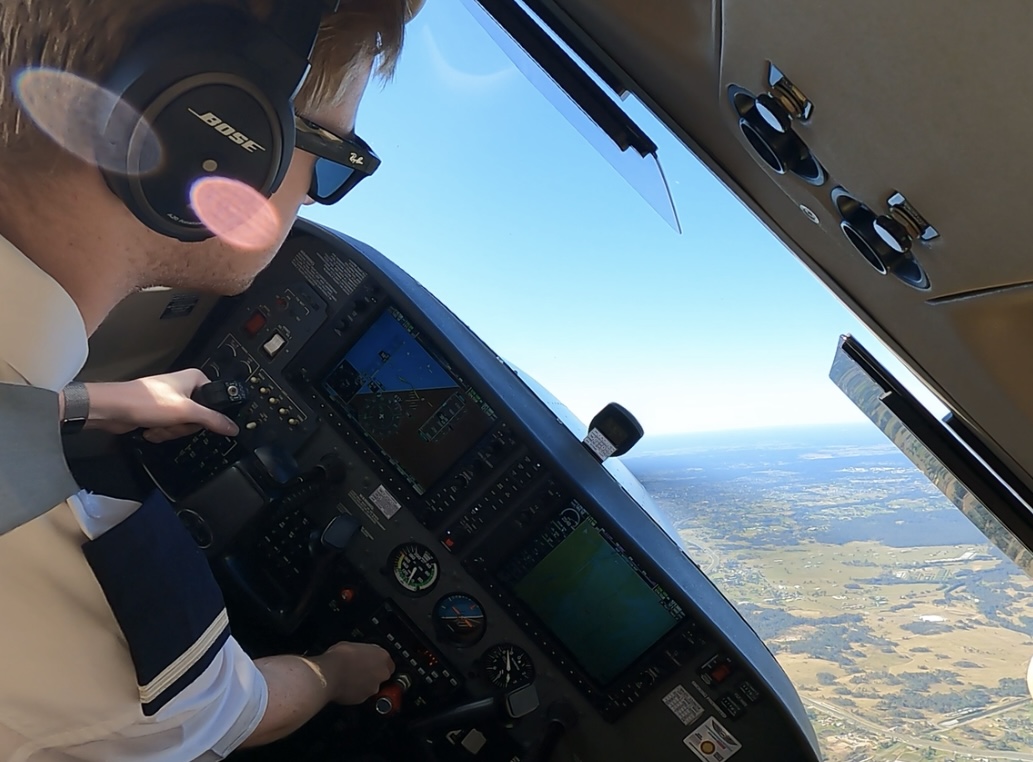
Learning to fly is full of moments that burn themselves into your memory—the first time you take off solo, the concentration of a precision circuit, the quiet pride of nailing a smooth landing. But few things compare to the raw thrill of learning steep turns.
The Skies Over Camden and Bringelly
Camden Airport became more than just my departure and arrival airport during flight training—it became a familiar anchor. Once you begin practicing steep turns, your world shifts. Climbing out of the Camden Airport control zone, and heading into to the training area, officially known as “D556B” the familiar fields and suburbs give way to rolling patterns of farmland and construction, with the rising skyline of the Western Sydney International Airport growing on the horizon like a monument to the future of Australian aviation.
Seeing the construction site a few thousand feet below you, soon to be a hub of air traffic – almost adds a poetic layer to flight training. I’m learning above tomorrow’s major runways.
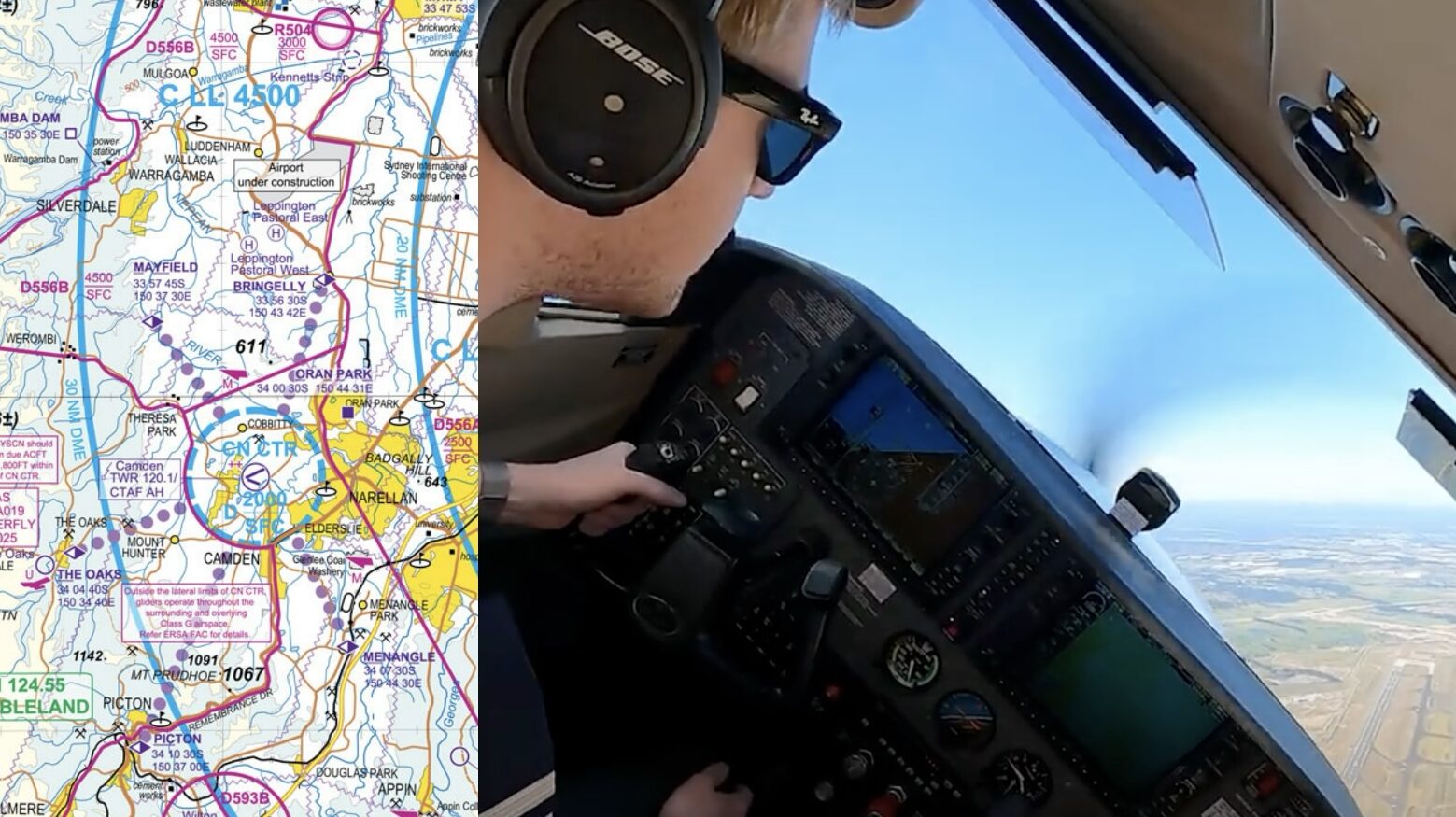
Right: Entering a steep turn over the Western Sydney International Airport (bottom right)
G-Forces and Geometry
At a 60° bank angle, the Cessna 172 demands commitment. You feel it in your body—about 2 G’s press you into the seat, your arms work harder to hold altitude, and the aircraft’s nose wants to drop. The horizon slices diagonally through the windscreen, and your senses sharpen.
Steep turns aren’t just about turning – they’re about control, precision, and resisting the subtle lure of a spiral dive. Let the nose drop too far and the bank steepen just a little more, and what started as a smooth manoeuvre can deteriorate very quickly into a tightening, descending turn. Airspeed builds rapidly, the descent rate increases, and without timely correction, you’re in a spiral dive—dangerously nose-low and losing altitude fast.
Lift the nose too high and you risk an accelerated stall, where the wing reaches its critical angle of attack at a much higher airspeed. It’s deceptive—because you’re moving fast, the stall catches you off-guard. One moment, you’re holding the bank with increasing back pressure; the next, the controls go mushy, the nose bucks, and the aircraft shudders as lift vanishes.
Fortunately, I’ve never experienced either of these, but I have learnt how to identify the warning signs, and get the aeroplane out of such an undesirable state. It’s a vivid reminder that steep turns live on the edge of discipline and decay.
Steep turns push you to feel the airplane, not just fly it. They force you to balance lift, G-load, and coordination with precision. When it clicks—when the turn is crisp, level, and perfectly coordinated—you don’t just see it on the instruments. You feel it. The airplane hums with energy, your hands settle into a rhythm, and the horizon swings around you like a compass needle. In that moment, everything—aircraft, sky, and instinct—aligns.
Chasing Your Wake
One of the most surreal parts of steep turns is the moment you fly back through your own wake turbulence. After completing a full 360°, the aircraft often gives a little bump—light chop that tells you, “You’ve been here before.”
It’s like flying into a ghost trail of your own path. You’ve just traced a near-perfect circle in the sky, and now you feel the invisible proof. That slight jolt is both humbling and deeply satisfying.
Learning the Feel of Flight
For a student pilot, steep turns are a turning point—literally and figuratively.
They demand your attention, precision, and confidence. It’s where you start to feel what real flying is: managing energy, reading the aircraft, and anticipating motion rather than reacting to it.
When you level the wings and your heading is bang-on, when the altimeter needle hasn’t moved, and when you feel that wake turbulence on cue—you know you’ve nailed it.
Final Thoughts
Flying steep turns isn’t just a lesson in aerodynamics—it’s a rite of passage. It’s where you stop feeling like you’re trying to control an airplane, and start feeling like you are the airplane. And for those couple of g-loaded, horizon-tilted seconds, nothing else matters.
Just you, the Cessna, and the arc you carve through the open sky.