
Last Sunday, I was reminded that some of the most valuable flights are not the ones where everything goes according to plan, but the ones where circumstances force you to think, reassess and make decisions that aren’t necessarily the ones you hoped to make when you walked out to the aircraft.
The plan for the flight was straightforward enough. Depart Camden, track north via Parramatta and Hornsby, continue East towards Long Reef, then join Victor One southbound along Sydney’s spectacular coastline. From there we’d continue past the Sea Cliff Bridge, track inland via Appin and Menangle, and return to Camden. It was a route I’d been looking forward to flying, offering a little bit of everything: controlled airspace boundaries, harbour views, coastline, escarpment and countryside.
As is often the case in aviation, however, the day began with a reminder that aircraft operate on their own schedule rather than ours.
The aircraft arrived later than expected, which immediately pushed our departure time back. Then came refuelling. Then another delay while waiting for an air traffic control clearance. None of these delays were significant in isolation. Five minutes here, ten minutes there. Yet aviation has a way of accumulating small, negligible delays into one which is significant.
By the time we finally departed Camden, I was already conscious that we had eaten into the comfortable margin I had originally built into the flight.
The weather itself appeared cooperative enough. Visibility was good and the route ahead looked inviting. We settled into the climb and tracked north-east across familiar landmarks. Parramatta slid beneath us. Hornsby came and went. The city sat off to our right, bathed in the afternoon light.
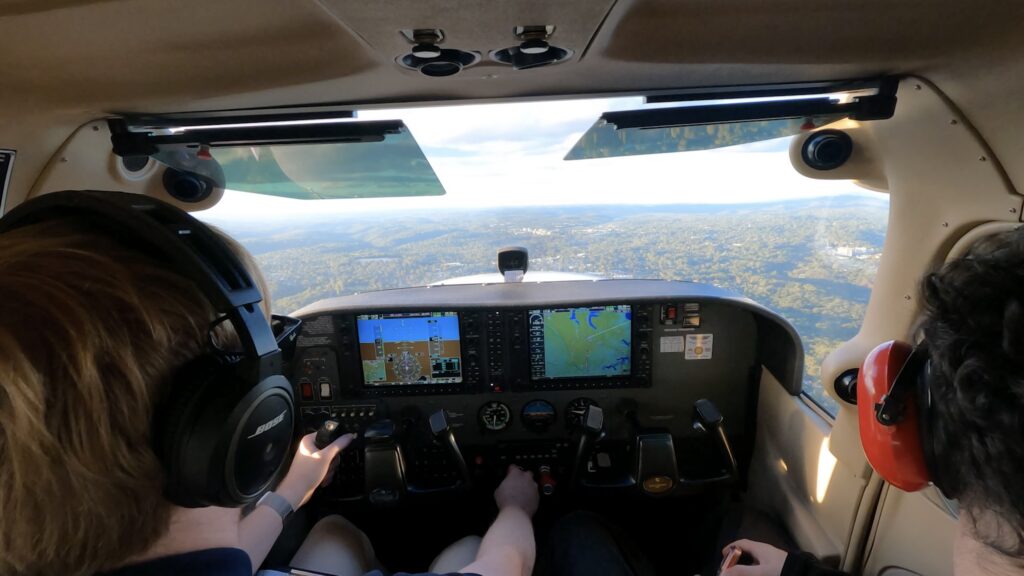
There is something uniquely satisfying about flying around Sydney on a clear day. The landscape changes constantly. Dense suburbs give way to bushland, waterways appear unexpectedly between ridgelines, and the ocean always seems to announce itself long before you actually reach it.
Approaching Long Reef, however, conditions began to change.
Nothing dramatic. Nothing dangerous. Just enough turbulence to remind us that the atmosphere is rarely as smooth as we’d prefer. Every now and then a bump would interrupt an otherwise steady cruise. Then another. Then another. The turbulence was probably best described as moderate at times—not severe enough to create concern, but certainly enough to become irritating.
As pilot, it was manageable.
As someone carrying passengers, it prompted additional consideration.
One of the realities of recreational flying is that our passengers often experience conditions very differently to the person in the left seat. Pilots tend to become accustomed to bumps and jolts. We know what the aircraft is doing. We understand the forces involved. We can anticipate what comes next.
Passengers don’t always have that luxury.
I knew that motion sickness could become a factor, particularly if conditions continued to deteriorate.
At around the same time, another factor was beginning to demand attention.
The headwind.
The forecast had suggested one thing. Reality was delivering something slightly different. Looking at our groundspeed, it was obvious that the wind was extracting a price for every mile we travelled south.
I recalculated our estimated arrival time.
The numbers weren’t alarming, but they were telling a story.
The delays on the ground, combined with the stronger-than-expected headwind, were slowly eroding the margins I had planned around daylight. We weren’t in immediate danger of arriving after last light, but we were drifting closer to the boundary than I was comfortable with.
The route ahead was also worth considering.
Victor One is one of Australia’s most scenic VFR routes, but it demands attention. Flying low-level along the coastline near Sydney is not necessarily the place I wanted to be while managing fading daylight, turbulence, passenger comfort and an increasingly compressed schedule.
As I looked ahead, I realised I had reached one of those moments that aviation presents from time to time.
The flight could continue exactly as planned. Or the plan could change.
The temptation to continue was certainly there. After all, we had come this far. The weather wasn’t terrible. The aircraft was performing perfectly. We could probably complete the route.
But “probably” is rarely the standard we should be aiming for.
Good aeronautical decision-making is often less about determining what is legal and more about determining what is wise.
The decision, when viewed through that lens, became surprisingly simple.
We turned around.
There was no drama to it. No emergency. No urgency. Just a calm, deliberate reassessment of the situation and a decision that the original plan no longer represented the best option available.
Instead of continuing southbound along Victor One, we tracked back towards Hornsby and entered the VFR Lane. The return journey took us back over familiar ground, down towards Prospect Reservoir and eventually inbound to Camden.
As often happens after making a difficult decision, the sense of uncertainty disappeared almost immediately.
The pressure was gone.
The calculations became comfortable again.
The remaining daylight margin increased.
Passenger comfort improved and the flight became enjoyable once more.
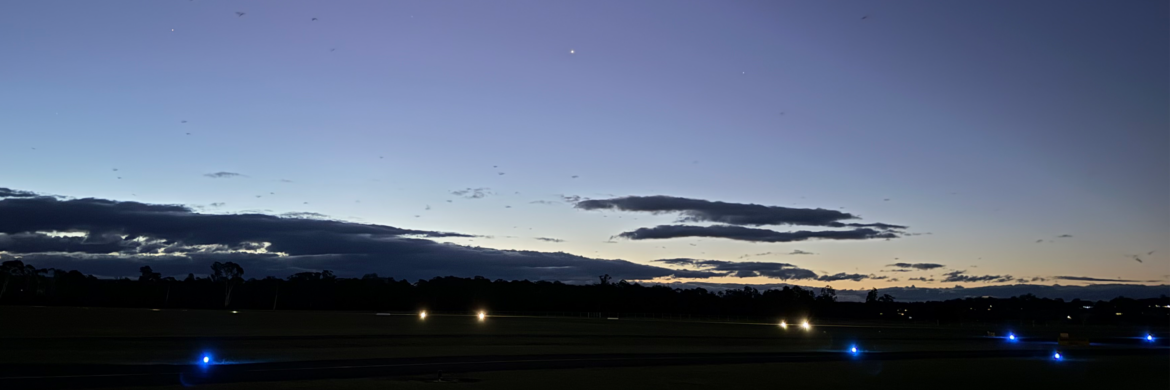
We landed at Camden almost exactly thirty minutes before last light.
Some might view the flight as incomplete because we didn’t finish the route exactly as planned. I see it differently.
The objective of aviation isn’t to complete every plan we make. The objective is to make good decisions throughout the flight, adapting when conditions change and recognising when circumstances no longer support the original intention.
In that respect, the flight was a complete success.
The aircraft returned safely. The passengers enjoyed the experience. Valuable lessons were reinforced. Most importantly, the decision was made while options remained plentiful, rather than waiting until circumstances forced a decision upon us.
Flying has an uncanny ability to teach humility. No matter how carefully we plan, the environment always retains a vote. Winds change. Delays occur. Conditions evolve. The mark of a competent pilot is not an ability to predict every variable perfectly, but an ability to recognise when those variables have changed and respond appropriately.
Last Sunday’s flight offered spectacular views, a few uncomfortable bumps, and a reminder that good judgement is one of the most important skills a pilot can develop.
The route may have been shorter than intended.
The lesson was not.
Leave a Reply